Retired Headmistress Reveals a Simple 21-Day Home System That Helps Nigerian Mothers Restore Their Child's Natural Focus and Concentration Without Medication, Shouting, or Extra Lessons

You know your child is bright.
You have always known it. You saw it in the way he asked questions as a toddler. You saw it in the way he would remember the lyrics to a song after hearing it twice. You saw it in the way he would spot something you missed entirely and point it out calmly, like it was obvious.
His teacher knows it too. She has said it to you four times now. "He is bright, but he gets distracted so easily."
And every time she says it, you smile and nod and say thank you... and then you drive home feeling like something is sitting on your chest.
Because bright is not showing up on his report card.
Bright is not sitting at the homework table without an argument. Bright is not remembering what you told him five minutes ago. Bright is not finishing a single page of exercises before he is looking out the window, bouncing his leg, fiddling with his pencil, needing the toilet, needing water, needing something, anything, except the work in front of him.
You have tried removing the television. You have tried locking the phone in your bag. You have tried sitting beside him for two hours to produce thirty minutes of actual work. You have tried the vitamins from the chemist... the ones the pharmacist said were good for brain development. You gave them to him every morning for three weeks. Nothing changed.
You have tried the lesson teacher. Three times a week. Good money. The teacher confirmed what you already knew. "He is smart, but he is not concentrating." You paid for that to be told to you.
Maybe something is really wrong with him.
That thought has come more than once now. You have pushed it away each time because it is too heavy to hold. But it keeps coming back. Especially late at night when the house is quiet and you are lying there calculating how many months are left before his common entrance, and the number keeps getting smaller.
And then there are the family gatherings.
His cousin. The younger one. The one who is already in a higher class, who reads chapter books, who sits still at the dinner table while your son is climbing the furniture. You smile. You say nothing. You drive home and sit in the car for longer than necessary before going inside.
I am running out of time. I am running out of ideas. And I cannot afford to get this wrong.
I know that feeling exactly. Because I lived it.
And today, by the grace of God and one chance conversation at a burial ceremony in Awka, I am going to tell you something that nobody... no teacher, no doctor, no pharmacist, no extra lesson teacher... has thought to tell you.
Drop everything you are doing now and listen to every word I am about to say.
The Method
This is not a new idea. It is not something invented in a laboratory by a doctor you have never met. It is knowledge that has been sitting quietly inside the experiences of Nigerian teachers and grandmothers for decades.
The women who raised this country knew something about children and food and rhythm that we have slowly stopped listening to. They knew that what a child puts in his mouth in the morning shapes what happens in his mind by afternoon. They knew that a child who does not wind down properly does not sleep properly, and a child who does not sleep properly cannot learn properly. They knew this without any research paper to cite.
It took me meeting one of them to remember it.
My name is Ngozi Okafor. I am 38 years old. I live in Enugu with my husband Chidi and our three children. I work as an administrative officer. I am not a doctor, not a child psychologist, not a nutritionist. I am a mother who was quietly desperate for two and a half years... and then I was not.
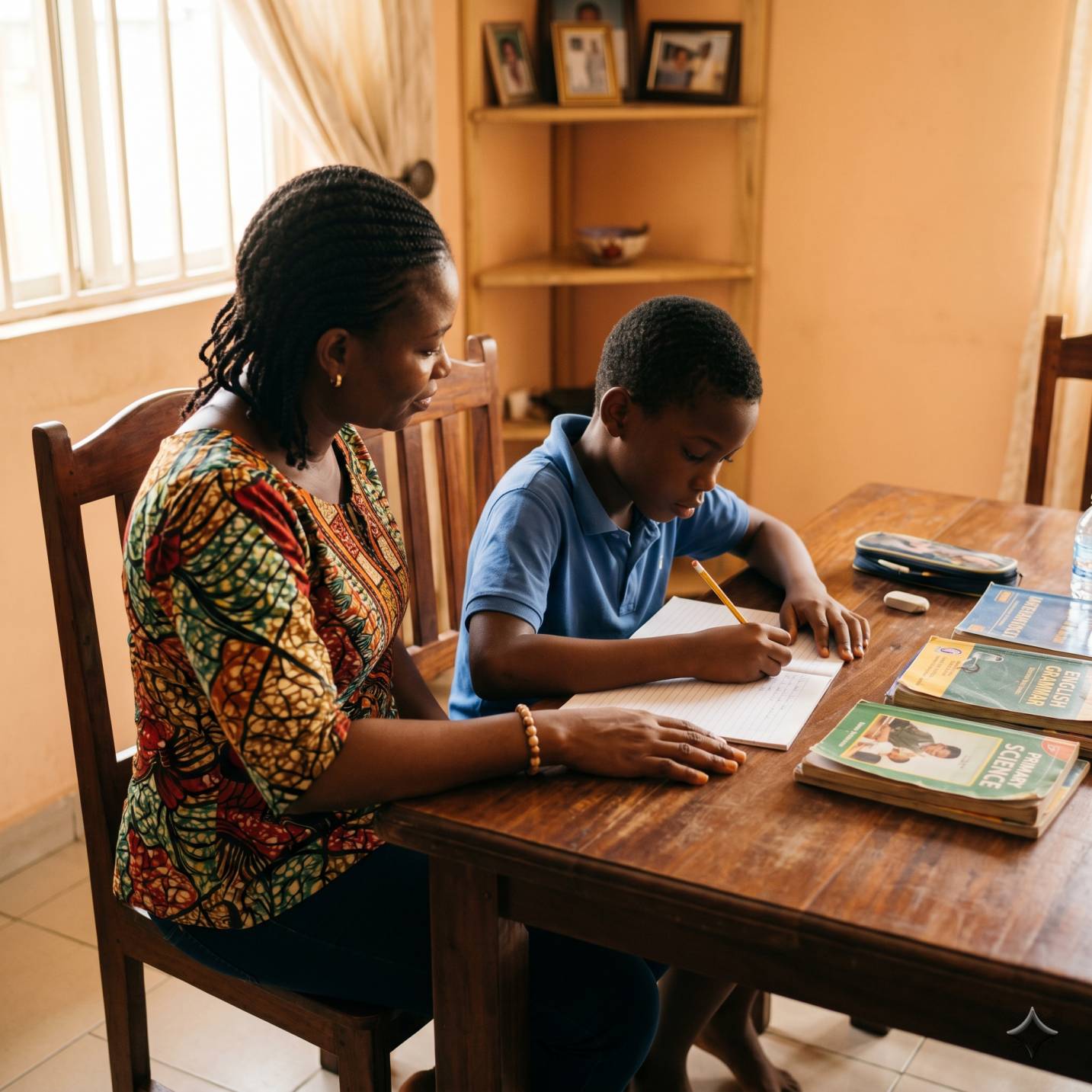
My Story
Emeka was a joyful child from the beginning.
He talked early. He laughed loudly. He had this way of looking at things... a toy, a bird outside the window, a leaf on the ground... as if he was memorising them. His nursery teacher told me he was one of the most curious children in the class. I kept that sentence in my heart for years.
Then he entered Primary 3.
The first note from his class teacher was polite. "Emeka is a bright boy, but he struggles to stay focused during lessons. Please speak with him at home." I spoke with him. He nodded. Nothing changed.
The second note was a little firmer. "Emeka is frequently distracted and is affecting the pace of the class." I felt the shame of that sentence like a physical thing. I went to the school and sat across from his teacher and apologised, as if his brain chemistry were something I had caused deliberately.
By Primary 4, homework time in our house had become a nightly war.
I would come home from work exhausted, cook, feed everyone, and then spend the next two hours sitting beside Emeka while he stared at his Mathematics book as if it were written in a language he had never encountered. He was not being stubborn. I could see that. His eyes would glaze slightly. He would blink. He would refocus... for approximately ninety seconds... and then he would be gone again.
I shout. He cries. I feel terrible. I go to my room. I pray. I come out the next morning and we start again.
That was our life. For two and a half years.
The Breaking Point
It happened on a Wednesday evening in October 2023.
Emeka had a Mathematics test the following day. He was sitting at the table. His books were open. I had read the same long multiplication question to him four times. On the fourth time, he looked at me with absolutely genuine confusion, as if I was asking him something he had never heard before.
I stood up, walked to my bedroom, closed the door, and cried.
Not out of frustration. Out of fear. What if this is real? What if something is actually wrong with my son that no amount of lesson teachers and removed phones and vitamins will fix? His test score the next day was 47 percent.
My older sister called that weekend. She had heard something in my voice, she said. She told me about a cousin's child who had been placed on medication after an ADHD assessment and how the family had never fully recovered from the decision. She was not telling me what to do. She was just... warning me. I said I understood and thanked her and hung up and did not sleep that night.
What I Tried (And Why None of It Worked)
Let me be honest with you about everything I did before I found what actually worked.
I hired a lesson teacher who came three times a week. He was patient. He was qualified. Emeka was equally distracted in those sessions as he was during school lessons. After four months and over eighty thousand Naira, his school scores had not moved. The teacher was kind enough to say so himself. "Madam, the child is not lacking information. He is lacking the ability to hold it." He could not tell me what to do about that.
I removed the television for six weeks. I kept the PlayStation in my wardrobe. I took his phone. What I got was a miserable, resentful child who found seventeen other ways to not do his homework. He stared at walls. He reorganised his pencil case repeatedly. He fell asleep. Homework still took two hours. Focus still dissolved in minutes.
I bought two different brands of children's multivitamin syrup. One of them was imported and cost more than I care to admit. I gave both of them consistently for three weeks. I saw no difference in his behaviour, his attention span, or his school performance. On the fourth week I forgot to give it to him and realised I had stopped noticing either way.
I tried the brain-boosting cereals. The ones with the children doing homework on the box with bright smiles. Emeka accepted one of them for two days and then refused it entirely. The other one he tolerated for about a week before announcing it tasted like cardboard. I ate the rest myself.
I removed his weekend outings as punishment for poor performance. It worked for one evening. By the following Tuesday he was back to the same patterns. And I had spent a weekend watching a ten-year-old be miserable in his own home, which did not feel like parenting. It felt like cruelty disguised as discipline.
I prayed. I want to say that plainly because prayer is real in my life and I do not dismiss it. I attended two church intercession sessions specifically for Emeka. I believe God heard me. But I had a growing sense... quiet but persistent... that God was waiting for me to also take a practical step. That the answer existed somewhere and I was being held back by not knowing where to look.
The Burial in Awka
In January 2024 my maternal aunt passed away and we travelled to Awka for the burial.
I was not in a good mental place. Emeka's common entrance was seven months away. His Mathematics score from the last class test was 51 percent. I had just had a difficult conversation with Chidi in which he suggested, gently but unmistakably, that perhaps we needed to lower our expectations for this particular child. I did not raise my voice. But I also did not forgive that sentence for several weeks.
At the reception, I was seated beside a woman I did not know.
She was small and precise-looking. Probably in her early seventies. She wore a plain ankara blouse and a simple wrapper and had the manner of someone who did not waste words. She introduced herself as Mama Obiageli Ezenwachi. She had been a headmistress, she said. Retired now. Community Primary School Awka, twenty-eight years.
She asked me how I was. It was the standard burial-reception question. I gave the standard answer. But she looked at me once more and said: "You are not fine. What is troubling you?"
I do not know why I told her everything. Perhaps because she was a stranger. Perhaps because I was simply too tired to keep carrying it alone. I told her about Emeka. The teachers' notes. The lesson teacher. The failed vitamins. The test scores. The fight with Chidi. The fear that something was genuinely wrong with my son's brain.
She listened without interrupting.
When I finished, she put down her food. She looked at me directly. And she said:
"Tell me what that boy eats for breakfast."
I blinked. Of all the things I expected her to say, it was not that.
"His breakfast?" I repeated.
"Yes. What does he eat every morning before school?"
I told her. White bread with Blue Band margarine and tea. Sometimes Golden Morn if I had time. Occasionally Milo with milk. Normal Nigerian morning food. The same food every child on our street was eating.
She nodded slowly. "That is the first problem. By the time that child reaches second period, his blood sugar has collapsed and his brain is running on empty. He is not distracted. He is starving. Not his stomach. His brain."
She paused to let that land.
"The second problem is his evenings. What does his routine look like from 6pm to bedtime?"
I described it honestly. Homework battle. Television or phone if he behaved. Dinner. Sleeping whenever he eventually fell asleep, sometimes past 10pm with the television still on in the background.
She nodded again. "His nervous system is still activated when he lies down. He is not sleeping deeply. He is resting with noise in his body. A child who does not sleep deeply does not restore his brain. He wakes up already behind. And then you feed him bread and tea and send him to school and wonder why he cannot concentrate."
She was not unkind. But she was very, very direct.
We spoke for nearly two hours. She gave me a specific list of breakfast foods I could find in any Enugu market. She described a seven-step evening routine that takes thirty minutes and requires nothing except time and consistency. She also described a simple way of identifying which of four biological causes was the dominant one in any specific child, so that the mother knows exactly where to start instead of guessing.
I wrote everything on the back of an envelope because I did not have paper.
Going Home
I will be honest. In the car back to Enugu I read that envelope three times and thought: This seems too simple. Surely if breakfast and bedtime were the answer, someone would have told me by now.
Chidi asked what I was reading. I told him. He said nothing, which in our marriage means he was skeptical but had learned when not to argue.
I implemented it the next morning.
Day 1. I changed Emeka's breakfast. He accepted it with less resistance than I expected. I did not explain anything to him. I just served it. He ate it and went to school.
Day 2. Same breakfast. I started the evening routine that night. He was resistant at first. He wanted the television. I stayed calm and held the boundary. He fell asleep forty minutes earlier than usual.
Day 3. Nothing dramatic. I was starting to doubt again.
Day 4.
Day 4 was when I noticed it.
I came home from work at 6pm. Emeka's school bag was already open. His homework book was on the table. He had completed two of the three exercises. Unprompted. Without being told.
I stood in the doorway of the sitting room for a long moment. I thought I was misreading the situation. I checked the date on the homework. I checked whether maybe a lesson teacher had come that I had forgotten about.
Nothing. He had simply sat down and done his work.
By the end of Week Two his class teacher sent me a WhatsApp message. "Good evening Ma. I just wanted to say I have noticed a real improvement in Emeka's participation in class this week. Whatever you are doing at home, please keep it up."
I read that message four times. Then I went to the bathroom and cried again. Different tears this time.
The Moment Chidi Noticed
Day 9. Chidi came home from work at around 7:30pm. He walked into the sitting room and stopped.
Emeka was at the table, head down, pencil moving, working through his English composition exercise. Nobody had asked him to. Nobody was sitting beside him. He had simply... started.
Chidi stood at the door for a full ten seconds. Then he looked at me and said:
"Ngozi. What did you do to this boy? Is this the same Emeka?"
I said: "It is the same Emeka. We just stopped starving his brain every morning."
He has not raised the topic of extra lessons since.
By Day 21, Emeka wrote a Mathematics class test. He came home and showed me the paper before I even asked. 74 percent. Up from 51 percent three weeks earlier.
The teacher had written at the bottom: "Well done, Emeka. Keep this up."
Other Mothers Who Tried It
At the burial reception in Awka I had not been the only mother Mama Obiageli spoke with that day. There were two others seated nearby who had joined our conversation.
Mrs. Adaeze from Onitsha, whose daughter was in JSS1 and had been described by four teachers in a row as having a short attention span. She had tried three different private lesson teachers. She implemented Mama Obiageli's breakfast change the week we returned. By the third week her daughter had completed her first full week of homework without a single argument. Her end-of-term position moved from 22nd to 14th.
And Chisom, a younger mother from Awka itself, whose son had already been referred to a clinic for ADHD assessment. She was desperate enough to try anything before the appointment. She followed the protocol. She cancelled the clinic appointment six weeks later. Her son's class teacher asked what had changed. She said she had adjusted his diet and his evening routine. The teacher said: "Whatever you are doing, please write it down for the other parents."
That is exactly what I did.
After I shared what happened with Emeka online, my DMs did not stop for three weeks.
Mothers in Lagos. Mothers in Abuja. Mothers in Port Harcourt. Mothers in London sending me voice notes at midnight. Every single one of them describing a version of the same story. Same teacher's note. Same failed lesson teachers. Same vitamins that changed nothing. Same exhaustion. Same guilt. Same fear.
I could not respond to all of them individually. I tried and it became impossible.
So I went back to Mama Obiageli. I asked her permission to put everything she shared with me into a proper written guide that any mother could follow at home. She agreed, on the condition that it be practical enough to use without any specialist support and culturally specific enough to work in a real Nigerian household with real Nigerian food.
I spent three months doing exactly that. I worked with a retired child nutrition specialist and a former school welfare officer to make sure every step was grounded in both traditional wisdom and accessible science. I tested it with nineteen families across Enugu, Lagos, and Abuja. All nineteen families reported measurable improvement within the 21 days.
I put everything... the full system, the diagnostic questions, the specific breakfast changes, the evening routine, the shopping guide, the weekly planner, everything Mama Obiageli gave me and everything I have learned since... inside one simple guide that any mother can use tonight.

Inside this e-guide, you will discover:
- The Child Focus Profile — a 10-question diagnostic that identifies your child's dominant focus blocker across four biological root causes, so you know exactly where to start and are not guessing in the dark from Day 1. Page 3
- The one breakfast ingredient found in almost every Nigerian home that collapses your child's blood sugar before 10am and the simple, affordable replacement you can make with ingredients from any local market — starting tomorrow morning. Page 8
- The Nigerian Focus Foods List — a printable shopping guide of locally available, affordable foods that support sustained concentration, with market names in Yoruba, Igbo, and Hausa so you can ask for them anywhere in Nigeria. Page 14
- The Focus Breakfast Swap Guide — seven Nigerian morning meal alternatives your child will actually eat willingly, tested on real children in Enugu, Lagos, and Abuja, that keep his brain fuelled and steady until afternoon instead of crashing before second period. Page 19
- The Evening Wind-Down Protocol — the seven-step, thirty-minute pre-bed routine that reduces cortisol, deepens sleep quality, and produces measurably better alertness and focus the following morning, even from Week 1. Page 26
- The Homework Environment Audit — a one-page checklist of five common features of Nigerian home environments that silently destroy a child's concentration every single day, with simple zero-cost fixes you can implement today. Page 33
- Mama's Weekly Rhythm Template — the permanent one-page weekly planner that keeps the protocol running effortlessly once your 21 days are complete, so the results last beyond the protocol and become the new normal in your household. Page 37
And the best part? You do not need to spend more money on lesson teachers, you do not need to clear your own schedule, and you do not need to fight your child to make this work. It is the same simple system that worked for Emeka, and has now worked for over 200 mothers I have quietly shared it with across Nigeria and the diaspora.
Real Mothers. Real Results.
Just So You Know... Putting This Guide in an Easy-To-Read Format Cost Me Over ₦287,500
Here is what went into creating this guide:
- Consulting sessions with Mama Obiageli Ezenwachi and two retired child education specialists to document the full protocol accurately and responsibly.
- Working with a retired child nutrition specialist to validate the breakfast and dietary components of the guide against current understanding of children's blood sugar and cognition.
- Market testing across Enugu, Lagos, and Abuja to confirm that every ingredient in the Nigerian Focus Foods List is genuinely available at local markets and at prices that real families can afford.
- Testing the full 21-day protocol with nineteen families across three cities and tracking outcomes carefully enough to confirm that the results were consistent and not accidental.
- Professional document writing, editing, design, and production to ensure that a tired mother sitting down at 9pm can read this guide clearly and follow every step without confusion.
I am not going to charge you ₦287,500. I will not even charge you ₦100,000. Not even ₦50,000. You will not even pay the standard guide price of ₦35,000.
Not even ₦12,000.
A fair price for this guide would be:
₦35,000For mothers reading this today, your investment is just:
₦7,500One-time payment. Instant download. No subscription.
This Discounted Offer is ONLY For the First 30 Mothers Who Order Today — So Please Hurry!
Secure checkout via Nestuge. Pay by card, bank transfer, or USSD. Instant download after payment.
WAIT! I Have THREE FREE Gifts For You...
If you are among the first 30 mothers to order today, you will receive these three exclusive bonuses alongside your guide. Today only.

BONUS 1: The Nigerian Focus Kitchen — 14 Brain-Feeding Meals Your Child Will Actually Eat
A standalone recipe guide built entirely around Nigerian ingredients available in any local market. Every recipe is designed around the same blood sugar and gut health principles in the main guide, but presented as practical, ready-to-cook meals your child will eat willingly. Each recipe includes a market shopping list with Igbo, Yoruba, and Hausa ingredient names.
You will never run out of ideas for what to feed him. And he will never know it is also fixing his brain.
Value: ₦6,500Yours FREE today

BONUS 2: The Screen Time and Focus Recovery Plan
Most mothers restrict screens, see improvement, and then lose everything the moment screens come back. This companion guide shows you exactly how to reintroduce screens after restriction without undoing a single day of the protocol's progress.
Step by step. Specific timings. Clear rules your child will actually accept. So the focus gains you worked for are permanent, not temporary.
Value: ₦6,500Yours FREE today

BONUS 3: The School Conversation Toolkit — How to Talk to Your Child's Teacher, Handle the ADHD Conversation, and Take Back Control of Your Child's Academic Story
Every mother in this situation has dreaded a phone call from school. This guide gives you the exact words to use when speaking to your child's teacher about the changes you are making at home, how to request progress updates confidently, and how to handle the ADHD assessment suggestion without conflict or panic.
You will walk into every school meeting knowing exactly what to say and how to say it. No more leaving the classroom feeling judged. No more nodding at things you disagree with because you did not know how to respond.
Value: ₦8,500Yours FREE today

First 30 orders only. Once 30 copies are claimed the bonuses are removed and the price returns to ₦35,000.
Other Nigerian Mothers Are Ordering Right Now...
See what is happening in our buyers group:
Bear in mind, you are not the only person viewing this page right now.
Yes! I Want My Bright Child Solution Before the Offer ExpiresSecure payment. Instant access. 30-day money-back guarantee.
My Bold 30-Day "Show Me Results" Guarantee
Still feeling unsure? I completely understand. You have already spent money on things that did not work. I would be cautious too.
Which is why I am making you this promise: Use the My Bright Child Solution for 30 full days. Follow the protocol as written. If you do not see a real, visible improvement in your child's focus and homework behaviour, send one email to publishinsight@gmail.com and every kobo will be returned to you.
No questions. No forms. No argument. No waiting.
The only way you can lose here is by not trying it at all.
I Am Ready — Get Me the Guide NowMore Mothers. More Results.
Questions Mothers Ask Before Ordering
Mama Obiageli was clear on this point. She said: "A diagnosis tells you a name. It does not tell you what to feed the child or how to structure his evenings." The protocol addresses the biological environment inside which any child's brain operates. Blood sugar stability and deep sleep are foundational regardless of any label. Several mothers who followed the protocol had children with formal diagnoses. They all reported visible improvement. That said, this guide does not replace your child's doctor and you should continue working with any healthcare professional already involved in his care.
The Focus Breakfast Swap Guide inside the protocol includes seven different alternatives specifically chosen because children actually eat them willingly. They are not unusual. They are not foreign. They are Nigerian foods prepared in slightly different ways or in different combinations. Emeka was a picky eater too. He accepted the new breakfast with far less resistance than I expected because it was not strange food. It was familiar food, prepared differently. And the guide tells you exactly how to introduce it without making it feel like a rule.
Yes. Every ingredient in the Nigerian Focus Foods List is available in Nigerian and African grocery shops in Peckham, Woolwich, Dalston, Handsworth, Moss Side, and most areas with a Nigerian community. The protocol was tested by mothers in Lagos, Enugu, Abuja, and London. The London mothers confirmed that every item on the list was findable locally. The Evening Wind-Down Protocol requires no ingredients at all. It is purely a routine.
Most mothers in our test group noticed the first visible difference between Day 3 and Day 5. Not a dramatic transformation. A small, clear shift. A child who sits down with one reminder instead of four. A child who completes one exercise without drifting. Those early signs are the protocol beginning to work. By the end of Week Two, the shift is usually clear enough that people outside the household begin to comment. Full results across all seven protocol tools are typically visible by Day 21.
Bonus 2 inside the package is called The Father's One-Page Briefing. I wrote it specifically for Chidi. It explains the entire solution in plain, direct language with no jargon, no long story, and no asking him to believe anything in advance. It simply explains what the problem is and what the protocol does about it. Hand it to him. Let him read it. You do not have to argue. The results by Day 9 will do the rest of the convincing.
Then you pay nothing. The guarantee is thirty full days. Follow the protocol as written. If you do not see a real, visible improvement in your child's focus and homework behaviour within that time, send one email to publishinsight@gmail.com and every kobo is returned. No questions. No forms. No argument. You are taking no financial risk here. The only risk is continuing to do what has not worked.
That concern is fair and I understand it. This is why the protocol is built around a single action on Day 1. Not a full lifestyle overhaul. Not a complicated programme you need to prepare for. One change to his breakfast tomorrow morning. That is it. Most mothers who act on Day 1 are still following the protocol on Day 21 because the results they see in the first week make it impossible to stop. The guide is designed to be used, not filed.
The Truth About Waiting
I know what waiting feels like. I did it for two and a half years.
I told myself I would try one more thing. Then one more thing after that. I told myself he would grow out of it. I told myself maybe next term would be different. I told myself I needed to do more research before I committed to anything new.
None of that was true. I was scared. Scared that I would try something else and it would fail again. Scared that the failure would mean something permanent about my son. Scared that if I ran out of things to try, I would have to accept a story I was not ready to accept.
So I waited. And while I waited, Emeka sat through another term of lessons he could not absorb. He wrote another set of tests that did not reflect what I knew he was capable of. He watched his confidence shrink slightly every time he got a paper back with a score that did not match the boy I knew him to be.
Waiting did not protect him. It just delayed the help he needed.
The mothers who get the best results from this protocol are not the ones who read every word of this page three times. They are the ones who read enough to trust it and then act. They change the breakfast the next morning. They start the evening routine that night. They do not wait for a perfect moment or a perfect week or a husband who is fully convinced or a child who is cooperative.
They start.
His common entrance is not moving. His term exams are not moving. The clock that has been sitting quietly in the back of your mind since the first teacher's note is not moving.
But you can.
Every day you wait is one more day his brain goes to school underfed and unrestored. You already know what that looks like. You have seen it for long enough.
You Have Two Choices Right Now.
Option 1: Take Action Today
Get the My Bright Child Solution. Start the Child Focus Profile tonight to identify your child's dominant focus blocker. Change his breakfast tomorrow morning. Start the Evening Wind-Down Protocol this week. Watch what happens by Day 4. And be the mother who did not wait until things got worse before she acted.
Option 2: Close This Page
Go back to the lesson teacher who already told you three times that your child is bright but unfocused. Keep sitting beside him for two hours to produce thirty minutes of work. Keep shouting and feeling guilty and trying again. Keep watching his common entrance date get closer. Keep smiling at family gatherings while his younger cousin sits still and your son cannot.
Maybe God wanted you to see this page today. Maybe this is the practical step that He was waiting for you to take. You already know the things you have tried have not worked. You have nothing left to lose and everything to gain.
₦7,500 only. Instant download. 30-day full money-back guarantee. First 30 orders only for the bonuses.
₦7,500 only | First 30 orders